Every Strength cycle ends the same way. In week 6 you come back to the lifts from your Baseline and do them again. People ask why we wait six weeks. Why not test in week 4, when you feel strong?
Because in week 4 you’re carrying three weeks of heavy work. The strength you’ve built is still hiding under fatigue. Test then, and you measure how tired you are, not how strong.
What week 5 is for
Week 5 drops the volume and keeps the intensity: doubles and singles, long rests. The fatigue clears and the strength stays. By Monday of week 6 the bar moves the way it should.
STWeek 6 / 6 · Test60 min
Test day
Strength, Week 6 / 6 · Test: Test day
A1
Back squat
Work up to a heavy single
A2
Box jump
3 × 2, full rest
B1
Bench press
Work up to a heavy single
B2
Chin-up
Max reps, one set
C
Farmer carry
1 × 40 yd, heaviest clean
Coach’s note: if the bar slows, that single is your number. We write it down and stop.
If the bar slows, the set is done. In a test week, that’s the number we write down.
Then week 7: a deload. Half the volume. It feels too easy. It’s meant to, and it’s why cycle 15 starts heavier than cycle 14 did.
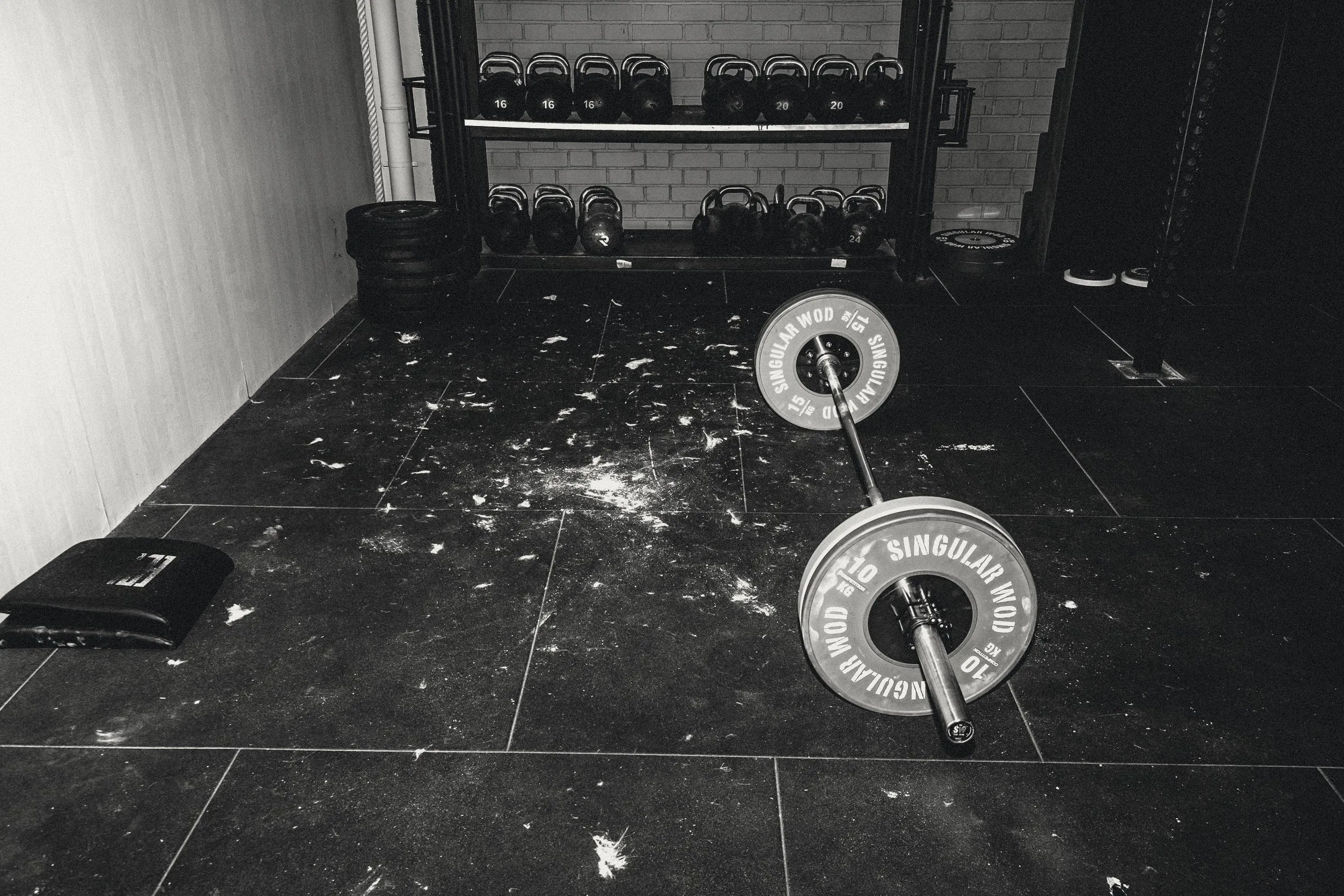
Test day on The Floor: chalk, a heavy single, and the log open on the bench.
Fatigue hides strength
Every hard session leaves two things behind. One is the adaptation you came for: a little more muscle, a nervous system that recruits it a little better, a groove that is a little deeper. The other is fatigue. The adaptation lasts for weeks. The fatigue fades in days.
In a heavy week the two arrive together, and the fatigue is louder. You’re stronger on Friday of week 3 than you were on Monday of week 1, but you can’t show it, because the bar is sitting on a body that squatted heavy on Monday and Wednesday. Test then and the number is honest about the wrong thing.
So the cycle is built to separate them. Weeks 1 to 4 pile up both. Week 5 lets the fatigue drain while the strength stays. Week 6 measures what’s left.
Weeks 1 to 4: what you’re building
Week 1 is the base: fives with two good reps left in every set. The loads are light on purpose, because the job is the groove, not the number.
Week 2 adds a little weight and keeps the reps. If the bar speed holds, the load was right. If it slows, we take it back.
Week 3 is heavy. Fives and threes on the main lift, the last set at an eight out of ten. This is the week most people want to test in, and it’s the week the test would lie the most.
Week 4 builds volume at weights you already own: more total work, nothing new on the bar. It’s the week that makes the peak possible.
None of these weeks asks for a maximum. Every set stops with reps in the tank, and the coach writes down how fast the last rep moved.
What test day looks like
Test day starts like every other day: the same ten-minute warm-up, the same order. Then we work up to a heavy single on each main lift, in jumps the coach sets from your log.
The rules are short.
One attempt per jump. If it moves well, the next jump goes on.
The coach calls the last attempt, not you. You get to argue once.
If the bar slows, the set is done. That single is your number.
No grinders. A rep that takes three seconds to come up teaches you to grind, and it tells us less than the rep before it.
Between lifts you rest as long as you need, usually three to five minutes. Nobody is racing the clock on test day. The session runs long on purpose, and the coach keeps the room quiet enough to hear the bar.
Most people finish with something in reserve. That’s on purpose. A heavy single that moved well is a better number to train from than a maximum you’ll never touch again.
Why a heavy single, not a max
A true max is a bad day out. It takes a long time to recover from, it’s sensitive to how you slept, and it rewards the people willing to grind a rep that a coach would stop. It also tells us very little we don’t already know from a fast heavy single.
A heavy single at full speed is repeatable. Test the same way every six weeks and you get numbers you can compare: same warm-up, same jumps, same rule about bar speed. The log turns into a line you can read.
What we do with the number
Your week 6 single sets the loads for the next cycle. Week 1 of cycle 15 is built from it, so the fives you lift in two weeks are a percentage of what you showed today, not of what you hoped for.
That’s why we care that the number is honest. Too high and the next six weeks are a grind. Too low and they’re a waste. A good test makes every session after it the right weight.
Why not test more often
Testing feels productive. You get a number, you can compare it, you can tell someone about it. So why only once every six weeks?
Because a test is a session that builds nothing. It spends a week of recovery to give you one data point. Do it every fortnight and a third of your training becomes measuring, and most of those measurements land in a heavy week, where they read low and make you doubt a plan that’s working.
The log already tells us most of what a test would. Bar speed on the last rep of a set, the load you used, how many reps were left: written down every session, those numbers move long before a test does. If your fives in week 4 moved faster than your fives in week 1 at a heavier weight, you got stronger. Week 6 confirms it with one clean number.
The deload is part of the test
Week 7 is a deload: half the volume, the same movements, nothing near a limit. It looks like a week off. It isn’t.
The deload clears the fatigue the test itself created, and it gives joints and tendons, which adapt slower than muscle, time to catch up. Skip it and cycle 15 starts tired. Take it and week 1 of the next cycle feels light, which is exactly how it should feel when the loads are built on an honest number.
That’s the whole shape: build, build heavy, build volume, let it settle, show it, rest. Six weeks to get stronger, one to prove it, one to recover. Then the log starts a new page.
If the number goes down
It happens. A cycle with a cold in it, a stressful month at work, a week of bad sleep before test day. The number is a measurement, not a verdict.
When a test comes in lower than the last one, we look at the log before we look at you. Did the bar speed hold through weeks 3 and 4? Did you miss sessions? Did the deload actually happen? Usually the answer is in there, and the fix is in the next cycle’s loads, not in a harder week 6.
If you’re new, your first test is your Baseline. Everything after it is a comparison with the person who walked in on day one.